2022-06-16|17 Oldenburg Digital Humanities Projects –Approaches and Experiences
Workshop
Linked data
Persons, Places, Events, Topics.
Experiences from epidat
and Buber Korrespondenzen Digital
slides https://digicademy.github.io/DHP
How to use this presentation
use spacebar or ← arrow keys → to navigate between the slides
use mouse 🖱 to open a link
Thomas
Kollatz
Digital Academy@Akademie der
Wissenschaften und Literatur | Mainz
 @kol_t
CC-BY
4.0
@kol_t
CC-BY
4.0
| epidat 🔗 | BKD 🔗 |
|---|---|
| research platform for Jewish epigraphy | Buber-Korrespondenzen Digital |
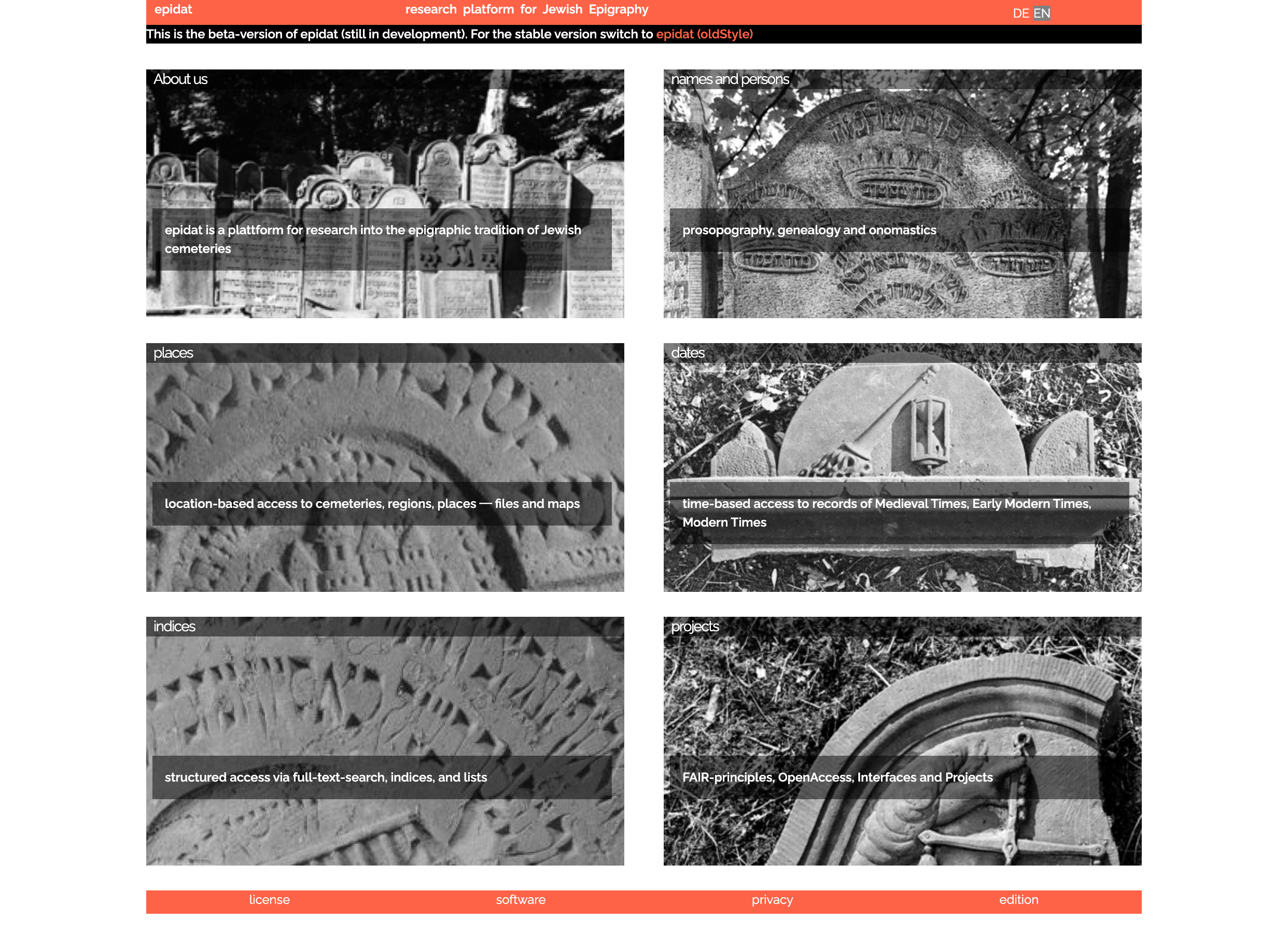
|
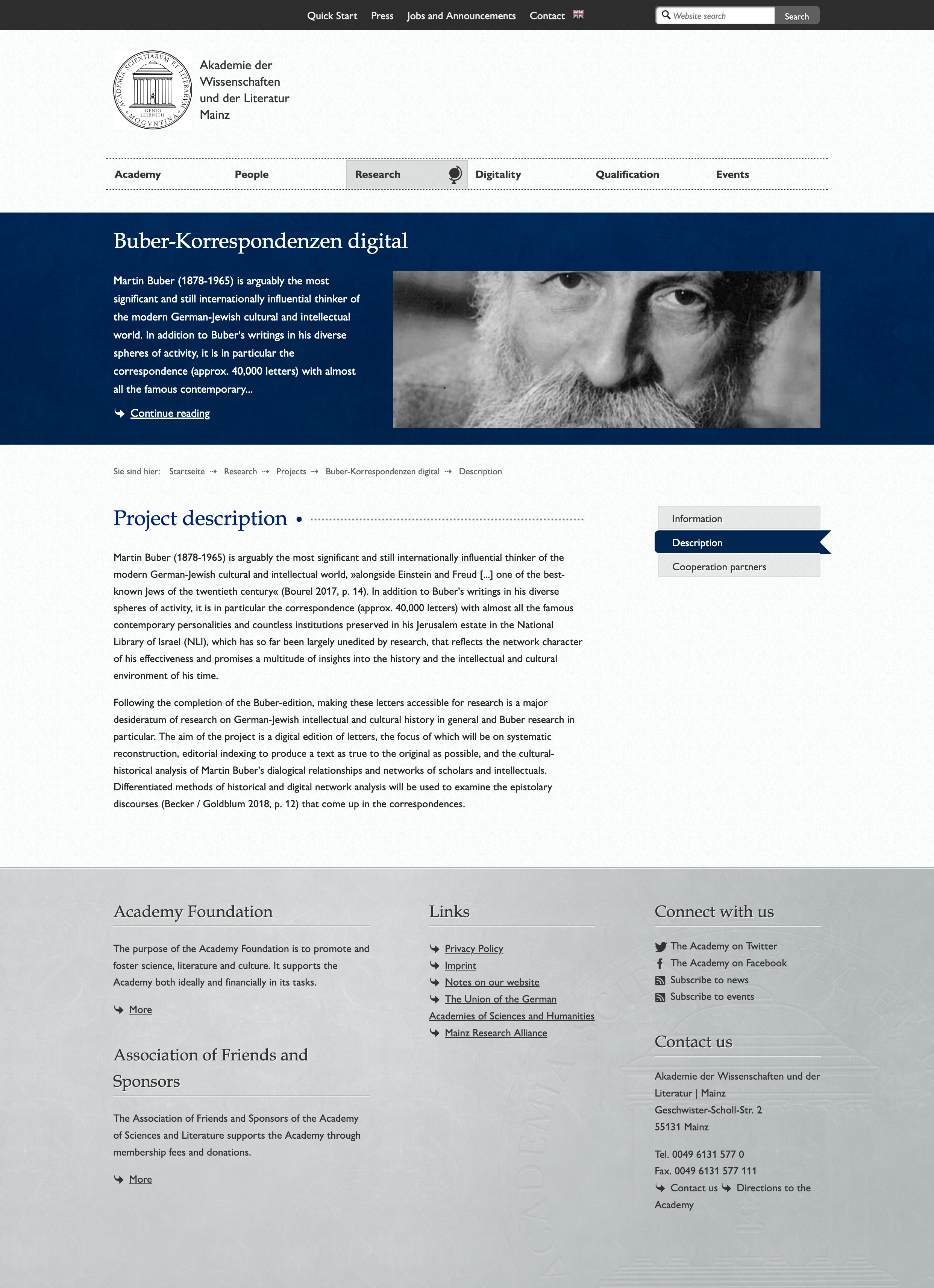
|
|
|
| 2002-… | 2021-2045 |
| FAIR | Research data should be ... |
|---|---|
| Findable | provided for human readers via html5, provided via a machine readable interface |
| Accesible | provided in a standard format usually TEI XML, epidat uses EpiDoc: TEI XML for Epigraphic Documents for machine readable, system-independent, program-independent and structured access (and widely used by digital epigraphers); BKD uses a TEI subset |
| Interoperable | mapped to authority files, controlled vocabularies and thesauri to maintain interoperability |
| Re-usable | released online under an open Creative Commons Licence cc-by or cc-by-sa |
| for more information see also How to harvest epidat records |
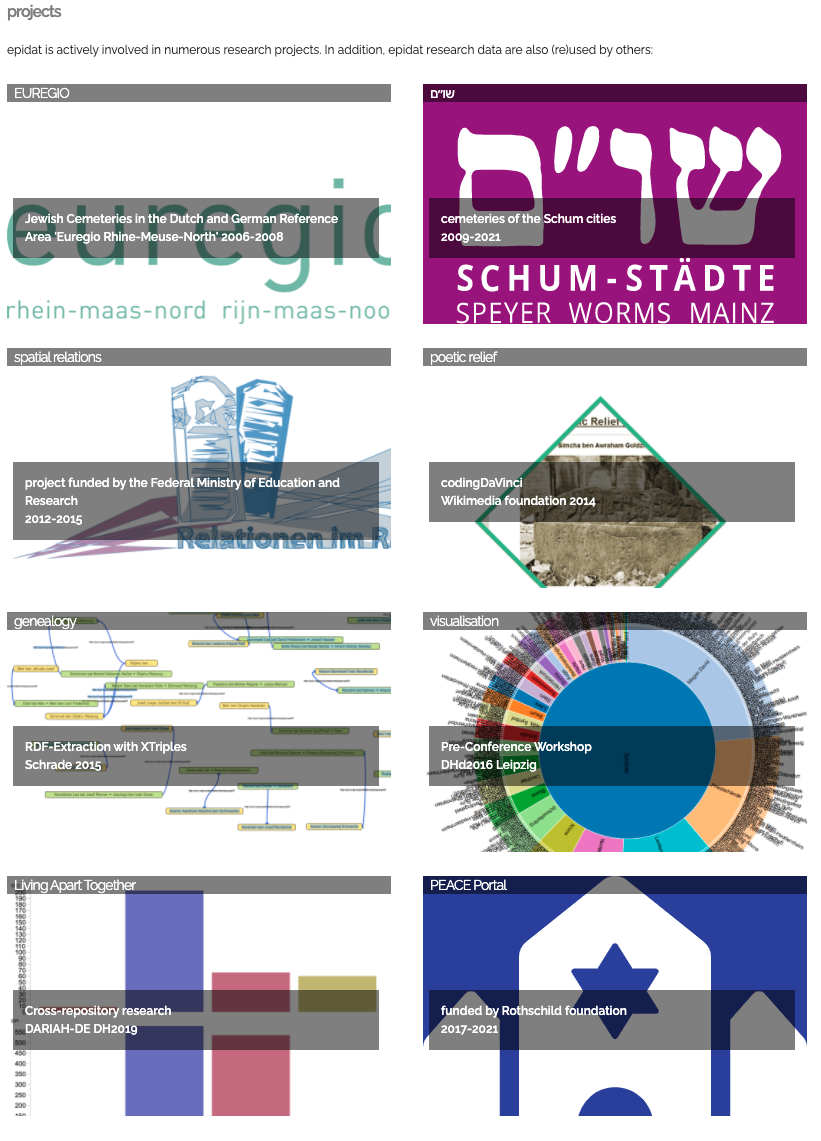
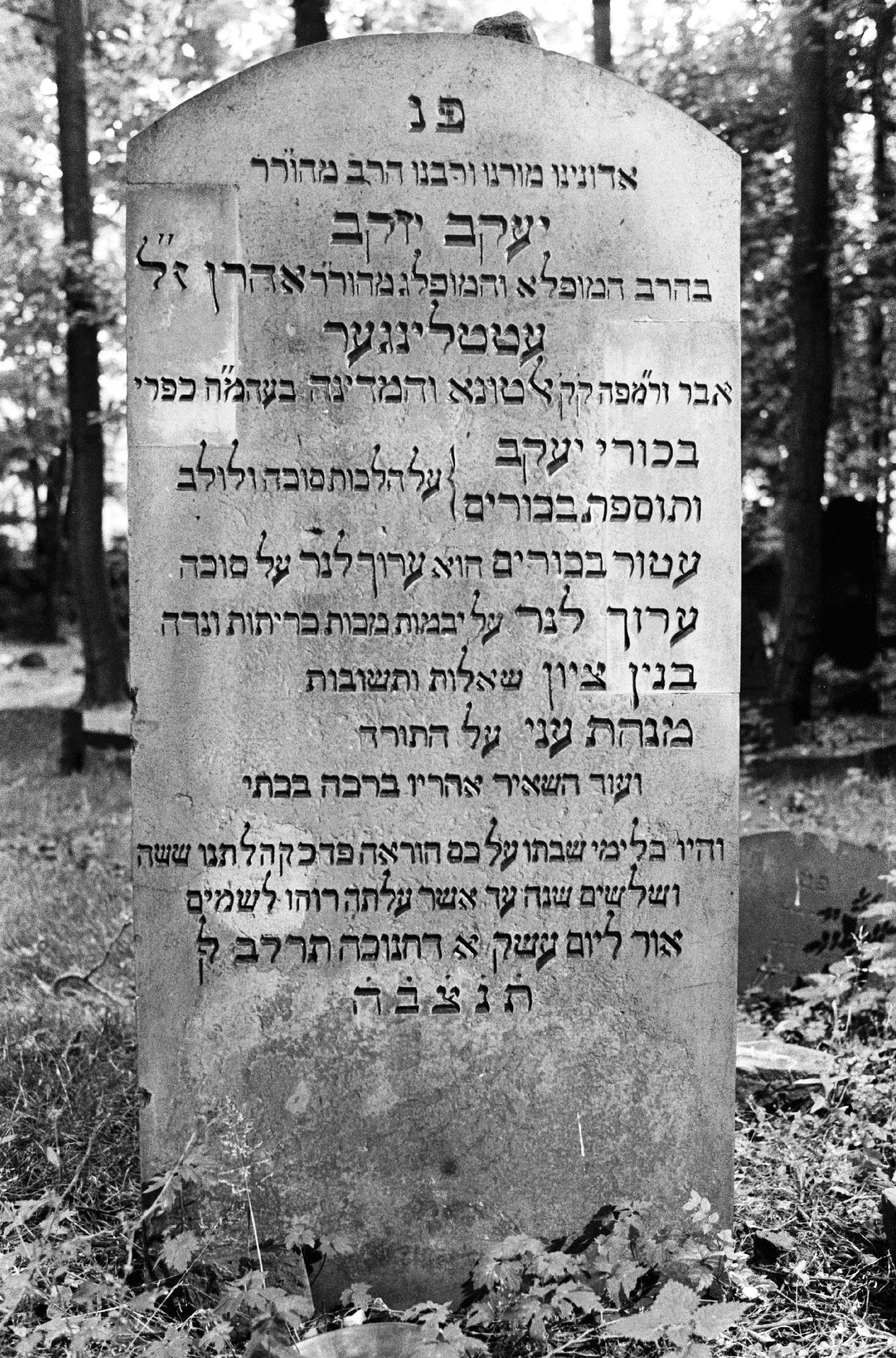
epidat object-ID hha-4210
headstone from epidat
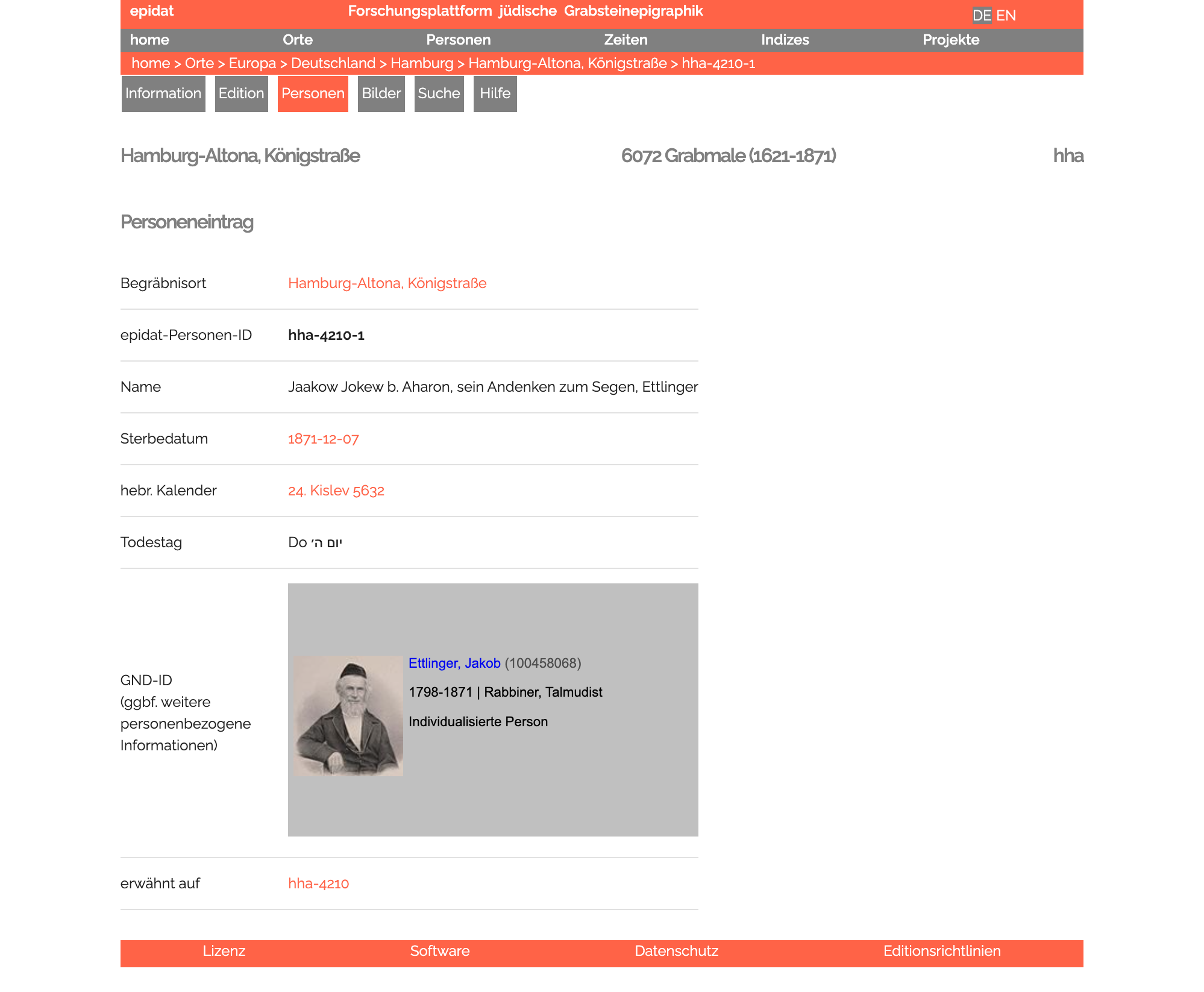
epidat person-ID hha-4210-1
person data in TEI XML
<particDesc>
 <listPerson>
  <person xml:id="hha-4210-1" sex="1">
   <persName ref="http://d-nb.info/gnd/100458068">
    Jaakow Jokew ben Aharon Ettlinger</persName>
   <death when="1871-12-07"/>
  </person>
  <listRelation>
   <relation name="spouse"
             mutual="#hha-4205-1 #hha-4210-1"/>
  </listRelation>
 </listPerson>
</particDesc>
4reference to authority file (gnd)9-10relation with other persons (spouse)- see Family relations in the Hamburg-Altona Epidat gravestone corpus by Torsten Schrade
What is TEI XML
The Text Encoding Initiative (TEI) is a consortium which collectively develops and maintains a standard for the representation of texts in digital form. Its chief deliverable is a set of Guidelines which specify encoding methods for machine-readable texts, chiefly in the humanities, social sciences and linguistics. Since 1994, the TEI Guidelines have been widely used by libraries, museums, publishers, and individual scholars to present texts for online research, teaching, and preservation. In addition to the Guidelines themselves, the Consortium provides a variety of resources and training events for learning TEI, information on projects using the TEI, a bibliography of TEI-related publications, and software developed for or adapted to the TEI.
What are authority files
authority files are databases containinga single, distinct spelling of a name (heading) or a numeric identifier for each topic, in order to collocate and disambiguate
cf. Wikipedia (en) art. authority control
Jaakow|Jakob|Jacob Ettlinger identified in …
- Gemeinsame Norm
Datei
(GND) i.e. authority file of the German National Library
http://d-nb.info/gnd/100458068 - Lobid provides Linked Open Data (LOD) services for
libraries, consisting of user interfaces (UIs) and application programming
interfaces (APIs).
https://lobid.org/gnd/100458068 - Key Documents of German-Jewish History
persons
https://jewish-history-online.net/person/gnd/100458068 -
BHR Biographisches Portal der Rabbiner
http://steinheim-institut.de:50580/cgi-bin/bhr?gnd=100458068 - Judaica Link – linking reference works of
the Jewish culture and history
https://data.judaicalink.org/data/html/gnd/100458068 - …
problem(s)
epidat has 49,737 persons but only 87 have a GND-identifier …
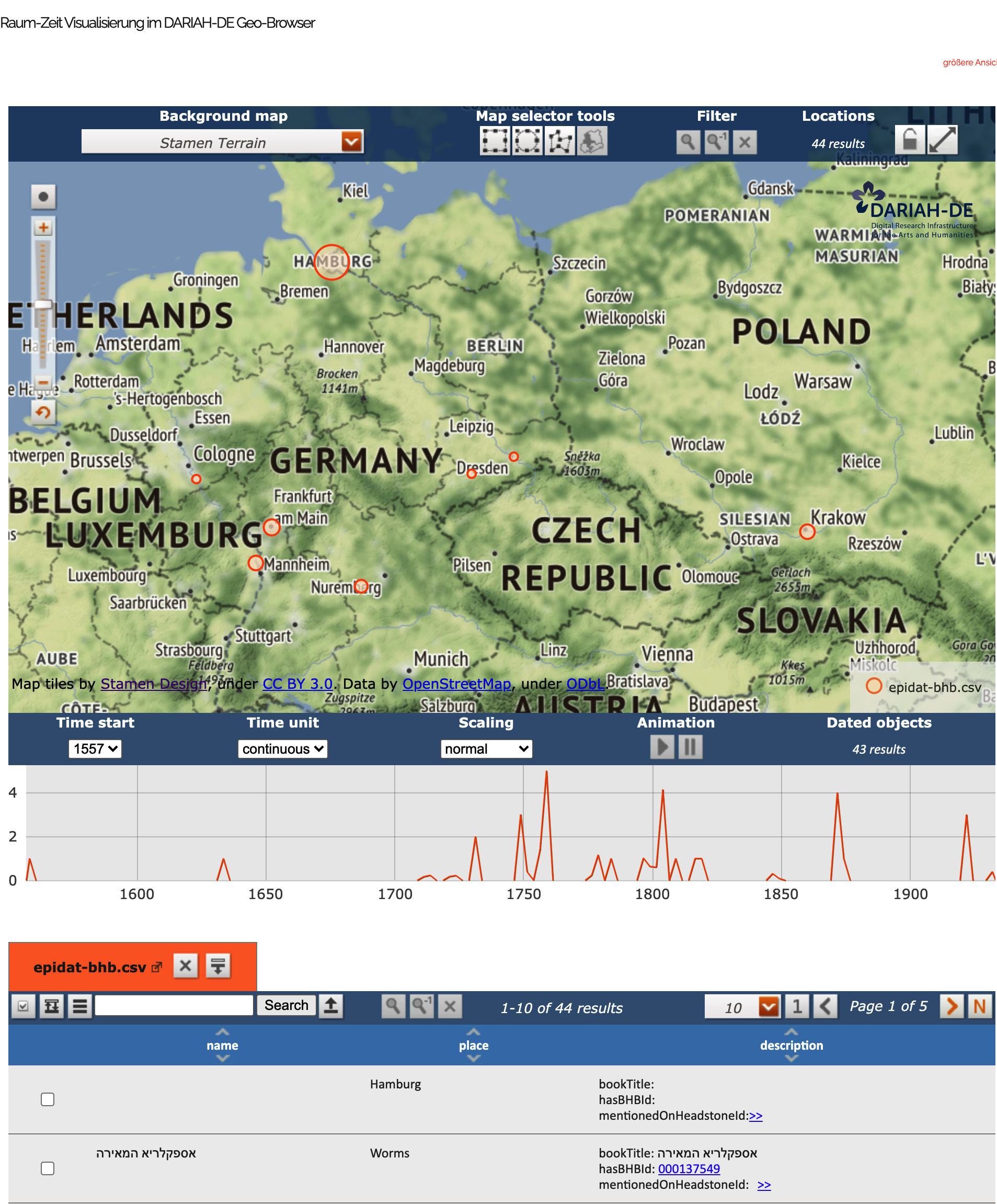
Ettlingers books
Particularly in the 18th and 19th centuries, it happens that epitaphs list books written by the deceased. From time to time, descendants also refer to books written by an ancestor. About 50 books are listed and presented in the spatiotemporal visualisation in the DARIAH-DE Geo-Browser.
Linking a book to a place to a timeperiod to a person
- dataset with 44 records
- bookTitle
- Bibliography of Hebrew Book ID
- link to epidat record
- date of headstone
- role of deceased: author or descendant of author
books mentioned on headstones epidat
Buber-Correspondences
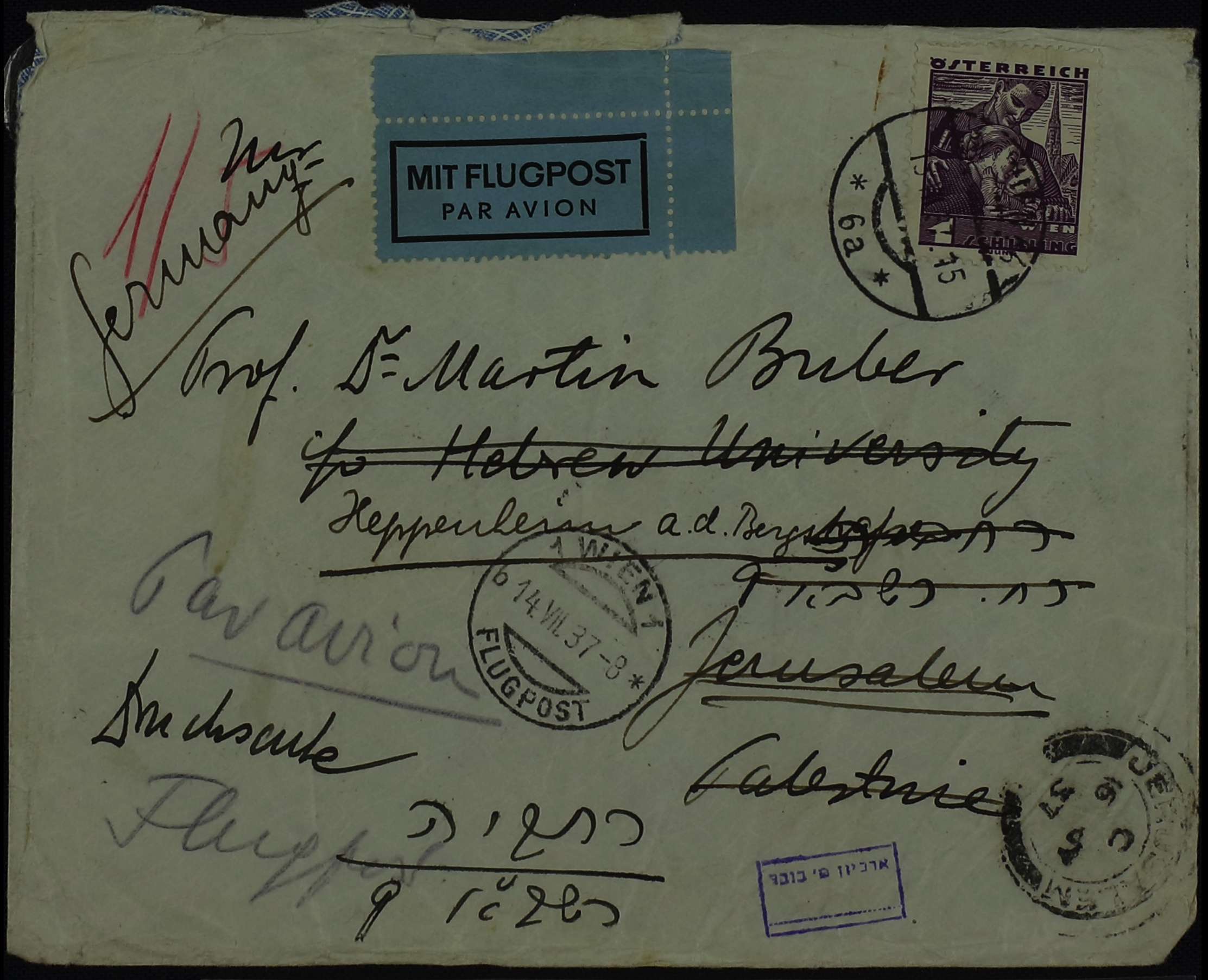
| sender | Martin Buber |
| receiver | Theodor Herzl |
| place (sent) | Wien |
| place (received) | Wien |
| date (sent) | May 21, 1903 |
correspDesc
<correspDesc>
 <correspAction type="sent">
  <persName  key="P.0000001"
             ref="http://d-nb.info/gnd/118516477">Buber, Martin</persName>
  <placeName key="O.0000007"
             ref="https://www.geonames.org/2761369">Wien</placeName>
  <date when="1903-05-21"/></correspAction>
 <correspAction type="received">
  <persName  key="P.0002131"
             ref="http://d-nb.info/gnd/118550241">Herzl, Theodor</persName>
  <placeName key="O.0000007"
             ref="https://www.geonames.org/2761369"
             evidence="external">Wien</placeName></correspAction>
</correspDesc>
☞ provide basic information about correspondence within correspDesc-Element
text
<div type="content" xml:lang="de">
<pb n="1"/>
 <opener>
    <dateline>Wien <date when="1903-05-21">21.V.03</date>.</dateline>
    <salute>Hochgeehrter Herr Doctor ?</salute>
 </opener>
 <p>Gestatten Sie mir, in Erwiderung Ihres werten
 <lb/>Schreibens von <date when="1903-05-20">gestern</date> an Sie die Frage zu richten, ob Ihrer Ansicht nach
 <lb/>die Form von <persName key="P.0003758">Nordaus</persName>
    <name key="W.0000028.01" type="work">Artikel</name> und die Art seiner Verbreitung geeignet
 <lb/>waren, auf die Entwickelung der Bewegung günstig einzuwirken. Beide
 <lb/>scheinen mir Ihrer eigenen Art <gap reason="deleted" unit="line" quantity="0.5"/>
 <lb/><gap reason="deleted" unit="line" quantity="0.25" />so fremd zu sein, dass ich unmöglich annehmen kann, <lb/>sie hätten Ihre volle <add place="above">und innerste </add>Billigung gefunden. Unsere <name key="W.0000021.01" type="work">Stellungnahme</name> ? <add place="above">die </add>nicht<add place="inline">s</add> <lb/><subst><del rend="strikethrough">die</del><add place="above">mit der</add></subst> gewisser gegnerischer Elemente <add place="above">zu tun hat </add>? war die unseres Erachtens notwendige
 <lb/>Reaktion. Eine wirklich starke <orgName key="K.0000001">Partei</orgName> wird es sich zum Ruhme anrechnen, <lb/>dass sie für die Meinung jedes Parteimitglieds ? <del rend="strikethrough">für </del>jede in correcter Form <lb/>ausgedrückte Meinung ? Platz hat. <g/>So die deutsche Sozialdemokratie im <lb/>Falle <persName key="P.0000444">Bernstein</persName>, während für die französische das Versagen in einem ähnlichen <lb/>Falle der Anfang vom Ende sein dürfte.<g/> <del rend="strikethrough">Nur </del><subst><del rend="overstrike">e</del><add>E</add></subst>ine gerecht und freiheitlich <lb/>geleitete Bewegung wird in der Stunde der grossen Parole jeden Mann <lb/>auf seinem Posten und alle Meinungen zu Einer Tat verschmolzen finden.</p>
 <closer>
<salute>Mit Zionsgruss und dem Ausdrucke der vorzüglichsten Hochachtung</salute>
<lb/><signed>Martin Buber</signed>
 </closer>
</div>
☞ markup of entities in transcription
abstract
<abstract>
 <list type="content">
    <item>Buber verlangt von Herzl eine Stellungnahme
    zu Nordaus Verhalten in der Altneuland-Kontroverse und
    betont die Notwendigkeit der Meinungsfreiheit innerhalb
    der zionistischen Bewegung.</item>
 </list>
☞ provide a human readable summary
persons | organisations mentioned
<listPerson>
 <person>
    <persName key="P.0000444">Bernstein, Eduard</persName>
 </person>
 <person>
    <persName key="P.0003758">Nordau, Max</persName>
 </person>
</listPerson>
<listOrg>
 <org>
    <orgName key="K.0000001">Zionistische Partei</orgName>
 </org>
</listOrg>
☞ provides human and machine-readable indices on entities relevant to the correspondence:
☞ one, unique key for each entitiy (person, place, organisation, work, event, keyword)
relations between entities
 <listRelation>
     <relation active="P.0000001" name="refersTo"    passive="P.0000444"/>
     <relation active="P.0000001" name="attacks"     passive="K.0000001"/>
     <relation active="P.0000001" name="opponentOf"  passive="P.0002131"/>
     <relation active="P.0000001" name="opponentOf"  passive="P.0003758"/>
 </listRelation>
</abstract>
☞ define relations between entities
☞ create a network of entities
☞ provide structured, entity based abstract of specific correspondence
levels of editing in BKD
| type | correspDesc | abstract | text |
|---|---|---|---|
| A | ✅ | ✅ | ✅ |
| B | ✅ | ✅ | |
| C | ✅ |
☞ Type B
provides an highly structured abstract enriched with metadata and lists of entities. It plays an eminent role in BKD.
analyse of relations of a correspondence
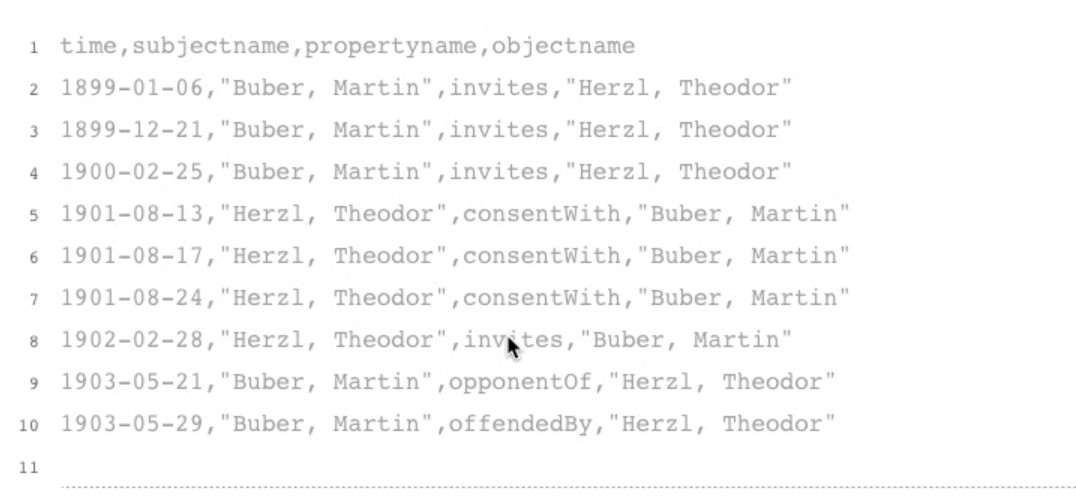
source: internship (Praxisprojekt) on relational data by Linnaea Söhn
analytical approach to correspondences
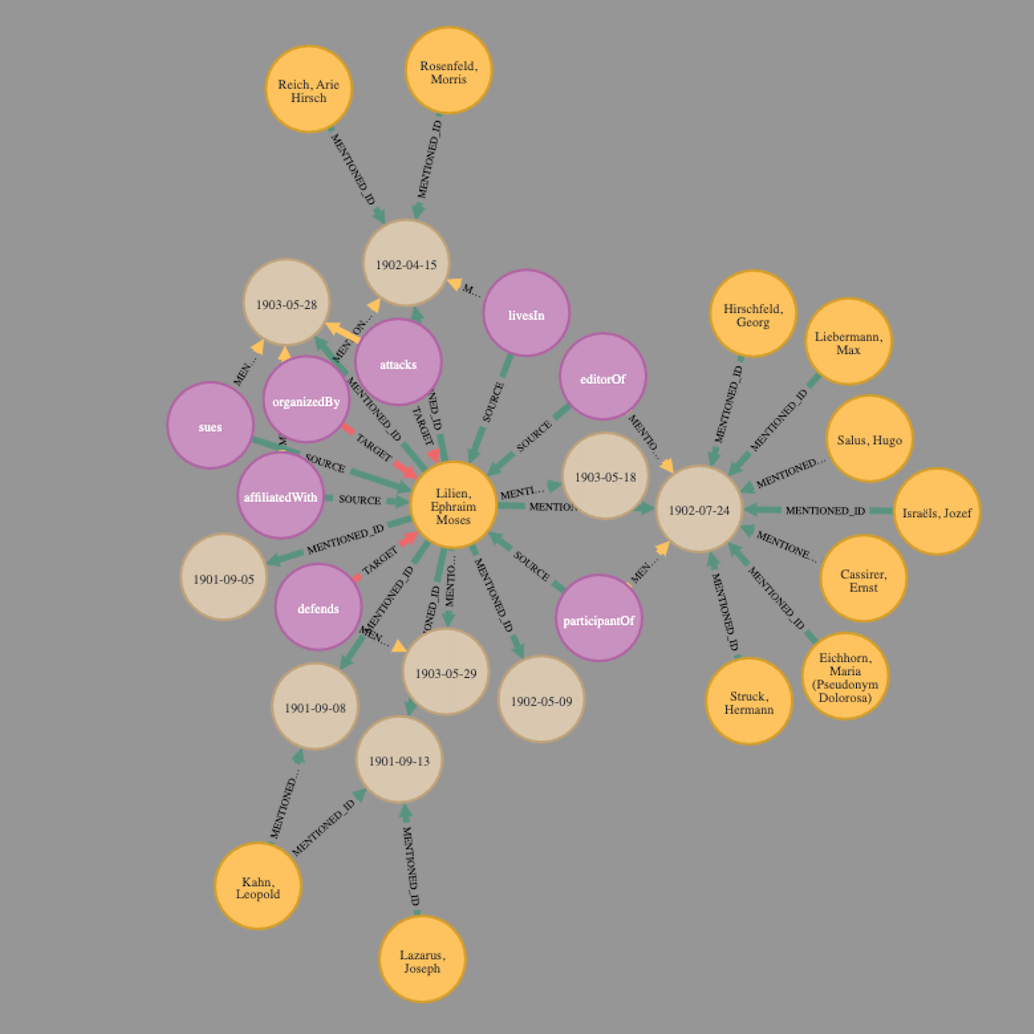
Visualisation generated with the help of Andreas Kuczera
mission statement
- focus more on relation(s) between entities …
- … full-text (transcription of text) is (probably) less important than structured capture of content